Monday, November 26, 2012

Books I've Loved: Lovely, Dark and Deep by Amy McNamara


Lovely package my copy arrived in - thank you Amy! 

I loved this book. Wren is a great character, and her interactions with others are believable. She's eighteen, spending a year after high school living at her artist father's house in the Northeast. All she wants is time alone to process life as it was and is - two very different variations. At heart she's a photographer, but she's put away her camera. Seeing the world is painful, and she feels like there's a false veneer she was led to believe all her life that has been stripped away.

Poetry is always just beneath the surface. From the title, I was a bit afraid Robert Frost would overshadow the story. But instead his appearance is a small one, with Larkin the poetry that Wren connects with as an extension of her own feelings. Poetry is not used as a gimmick or an easy spandrel. It is a realistic part of the world. Which is to say, it comes and goes at the moments when Wren needs the words.

Along with the setting and the use of the present tense, the poetry gives the book a feeling of suspension in time. This mirror's Wren's situation, and helped me to connect even more with her.

Wren's in the process of grieving over a lost friend, but her experiences are also related to depression. McNamara's writing provides a realistic window into how such an experience affects not only the person in the center of these emotions, but also everyone connected to her.

This is a big book, much thicker than most other YA novels on my shelf, but I never lost interest or felt the story flagged. This is one of those books that is a great companion, and I was sad to finish the story and place it on the shelf.

One last note: the cover art and binding are gorgeous.


*I received this book as a giveaway on Nova Ren Suma's blog, 99 distractions.*

Tuesday, November 20, 2012

MFA Flashback: The Bound Thesis

Once I defended my thesis, the graduation process was far from over.

I was elated to be done with the oral defense of my thesis. It was a wonderful experience, and one that prepared me for future job interviews. But the saga of the thesis copies had yet to begin.

As a graduate student, your thesis becomes part of your university's legacy. The library, your department, and often your advisor will want a bound copy of your thesis. You may say, "that's nice, I bet I could just whip up a cost-effective copy through a print on demand service." But no! Alas, the path through this final requirement is much thornier.

In order to graduate, you have to organize the printing and binding of your thesis. The format must be approved by the Graduate School, and must include strange formatting like 1.5" left margins. The student is responsible for printing four copies of the thesis on 100% cotton paper, and then the university library organizes the binding of each copy.

To make a long story short, I will say that organizing the printing and delivery of your thesis from the other side of the country is a fate I do not wish upon you. If you find yourself in such a situation, I hope you are as lucky as I was and have an amazing department mastermind on your side like Leah Aronow-Brown.

Once my printed, unbound copies arrived at the graduate school it marked the last hurdle needed to confer my degree.

Now I had to wait.

The binding process takes a long time. Usually, they will not arrive until several months after your graduation date. I graduated in the summer, and I received my bound thesis copies yesterday, in late November.

I wasn't sure what the bound copies would look like. I'd never seen one in person. So I began daydreaming about green cloth covers with gold embossed letters, artisan embellishments in the interior cover.

But the thesis copy is more of an academic document, bound to be shelved in a library archive. It is still lovely, but in a more sterile way.
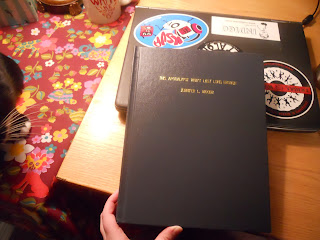
The cover is black but looks kind of plum in a certain light

Shadow in a rare still photograph


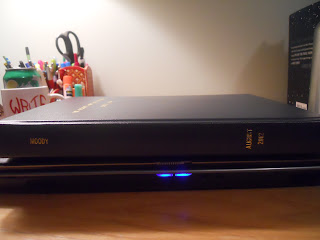
This thing is thick - a solid 1 1/2 inches.
The page total is right at 150.

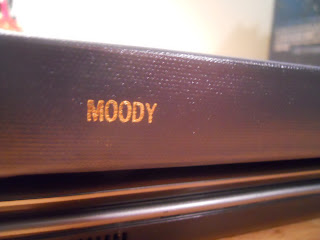
The side is printed with my last name at the top
and the bottom has the date of graduation, August 2012.

Woot!

Still, it's pretty cool to see my name stamped into a book cover.

As a general warning: thesis copies are expensive. Paying for them was a joint graduation present from my mother and father. Some of the copies are mandatory, like one for the library and one for your department. You cannot graduate until those copies are paid for and arranged.

But you also have the option of ordering additional copies. My family members wanted copies, so we ordered several. I wish I had made a separate version of my thesis for my family and a few friends, either through a print on demand site or as a xeroxed and hand-crafted zine. I could have designed a lovely cover for it no problem, and would have made sure to include an Acknowledgements page (which in the rush and stress of my thesis defense I forgot to include in the university version).

I'm submitting several of my thesis stories to journals, both literary and genre, so I don't want to put them up on amazon as a collection at the moment. But a private copy for family would not be considered publication.

I think I might go ahead and see if I can make a few copies of my thesis this way. There are still family members who won't get a library bound copy, and friends and advisors I'd like to thank for their help during my MFA years. Mark Pantoja's Kickstarter short story collection was beautiful, and sits proudly on my shelf. I'd like to have something lovely to give to my friends as well.

But I think it is also oddly fitting that my thesis, This Apocalypse Won't Last Long Enough, looks like a book that would survive the apocalypse and might be found in a government stronghold that a few straggling survivors use as a way station.

Tuesday, November 13, 2012

My First Novel: Stepping Stones in the Mire

I recently applied for a fellowship that had me rummaging through my files for a screenplay I wrote during graduate school. I began the screenplay during an Introduction to Screenwriting course and expanded it during an Advanced Screenwriting independent study. When I opened the file with the name of the screenplay I had worked on during grad school, it was as I remembered it - a bit of a mess but with some great visual scenes.

I set into work revising it for a few minutes and then something ticked in my brain. Wait - what was that other file in my screenplay folder?

I went back and there was a title I didn't recognize. I opened the document and I remembered - I'd spent weeks rewriting the screenplay during the stint when I'd wanted to switch my graduate thesis focus.

This version - the revision of my graduate screenplay - was really good. The scenes were specific, the characters three-dimensional, the push of the story more likely to grab a reader or viewer and pull them in. It was surprising how big the distance was between the two versions. There was a leap from idea to execution, from mucking about and finding the story to telling the story with confidence.

Photograph by clrcmck
Used under a Creative Commons Attribution-ShareAlike License

I'm working on my first novel, aided by goals with my writing buddy, NaNoWriMo word counts, and nudges from writing friends. What I've found interesting so far is that I can already tell the difference between my original story concept and where the novel is headed. I spent quite a while brainstorming about this story, but nothing clicked until I sat down and started writing.

My worst enemy in this writing process is the voice inside my head saying that this is all crap. And of course this book will need to be revised. Of course. That's when the book is really going to start to sing. I can't catapult myself from one shore to the other via the clean air. I'm going to have to wade through the water.

Looking at an early and late draft of my own writing at this point, when I'm feeling adrift in a big project, has given me the drive to keep going. I'm confident that I can revise this novel and make it cohesive, deeper and brighter than this first draft. The strange trick is freeing myself to write without beginning that revision process too early, starting off an endless cycle of editing myself out of the story before it is even written.

How's your novel going?

Wednesday, November 7, 2012

Waylines Magazine: New Market for SF Stories and Films

David Rees-Thomas was in my Clarion West class in 2011. He's a wonderful fellow - a sharp reader, a lovely poet, and a good friend. He's been a Managing Editor at Ideomancer for a while, and he's decided to start his own magazine along with Darryl Knickrehm, whom I do not know but who has stellar design skills.

The new magazine is called Waylines: Speculative Fiction and Film. They're looking for submissions of short stories and short films. Their website is professional and easy to navigate, and they will pay $40 per story. It's a great market, and I'm looking forward to reading the first issue. 

There's also a Kickstarter project, where you can get very cool postcards and such along with issues of the magazine. 

Here's their Kickstarter video. It's short (under 3 minutes) and is really well-done. 


I'm going to back this project on Kickstarter because as a writer I want to support great new venues for the fiction I love to read and write. And I know this is going to be a wonderful magazine.

Here's a quick peek at their Kickstarter progress, in case you'd like to contribute, too.

Monday, November 5, 2012

MFA Flashback: Visiting Writers

J.T. Dutton and Me, 2010, Photo by UAF staff photographer
One of the best experiences during my time as an MFA student was the visiting writer series that my department sponsored. Even though we were in Alaska, my program brought amazingly talented and accomplished writers up to visit.

The visiting writer would give a lecture on Thursday afternoons about their craft interests and areas of expertise. These lectures were open only to MFA students and English faculty, so they were cozy affairs where you really got to  know the writer and ask questions. And the writer had time to respond to those questions slowly and with care. It was almost like taking a seminar class with the visiting writer.

On Friday evenings the writers gave a public reading open to the entire campus and community, followed by a book signing where the local bookstore provided copies for sale.

But there's another element of the visiting writer that takes place earlier in the week, around Wednesday or Thursday.

Second and Third year MFA students have the opportunity to participate in a one on one manuscript discussion with a visiting writer. The visiting writer only meets with a few students (there isn't much time for more), and there are usually around six visiting writers each year. So meeting with a visiting writer is a once in an MFA experience for most of the grad students in my program.

My thesis advisor asked me if I'd like to meet with YA author J.T. Dutton, and I was ecstatic at the chance. I emailed her around twenty pages of the novella I'd been working on, and wrote the date for our appointment in my calendar.

I was terrified of meeting Dutton. I was afraid she'd throw my manuscript in my face and tell me I was a horrible writer and that I shouldn't have wasted her time with my silly story.

Instead, she gave me one of the best critique sessions I've ever received. She went over some language and pacing edits with me that snapped the opening of my story to life. It was amazing to watch my story wake up from my lumbering prose just by a few scratch marks through extra words, a few arrows to rearrange sentences in the paragraphs.

Next we moved onto larger discussions about story, and about writing YA. It was the first time I had met someone who wrote YA fiction. So many of my favorite books are considered YA, but for some reason I had never entertained the idea of writing YA as something that MFA graduates did. But J.T. Dutton's novel Freaked was based on her MFA thesis at UAF. I think I had a prejudice that YA fiction couldn't be serious, and that only serious writing mattered.

At the reading on Friday night, J.T. read a passage from the end of her novel, and it is a reading that both my partner and I remember to this day as being an amazing experience. It was a beautiful passage about being at a Grateful Dead concert and the feeling of being in the crowd.

Freaked and Stranded by J.T. Dutton

J.T. told me something important during my one-on-one critique session. "This is a novel," she told me. "A YA novel."

That story is still with me, and I haven't written it into a novel just yet. But I know that I can, and that it can be as sad and serious as I want and still be a beautiful YA novel. And it can also be funny and geeky and talk about Star Trek, and those aspects might even make it a much better story.


Tuesday, October 30, 2012

Big Ideas and Permissions

“Writing a novel is like driving a car at night. 
 You can only see as far as your headlights, 
but you can make the whole trip that way.” 

- E. L. Doctorow

I'm slowly growing more comfortable with the idea of stepping into a novel without a detailed outline. I've tried making an outline using the feminine journey in the back of 45 Master Characters, but I always get hung up. Why? Because I haven't spent enough time with my characters and their story to know who they are.

I've got three novel ideas, and I keep switching back and forth between them, unable to commit to pursuing just one. NaNoWriMo is about to start, and the days between me and the 10,000 word goal by November 15th are steadily disappearing. I'm kind of in novel freak out mode.

I have two wonderful writing friends to thank for pulling me out of my pre-novel funk.

Alisa Alering sent me a wonderful article by Bruce Holland Rogers about deciding on your Big Picture: why you are writing this novel. Each of my novel ideas has a different practical and creative purpose in my writerly big picture. One is a YA, one is literary/ experimental, one has a good feeling of forward motion. The YA would be writing for a great audience that I am eager to connect with, and would give me the satisfaction of finishing a story that I've been writing on and off for years. The literary one might never see the light of day, but it would give me the opportunity to unlock some stories and language I've been keeping stowed away. And the one with a good feeling of forward motion feels like one I could finish, that would prove to myself that I can write a novel, and would have enough of a structure to not melt into disparate parts after draft zero is done.

So what is most important to me in this first novel attempt?

My guideposts
With these in mind, my choice of which novel to write is much easier. I'm going to write the one with the sense of forward momentum, the short story idea my thesis advisor asked me about three years after it was workshopped in her class, about a body-modified raven and a lost girl searching for something that others are trying to hide.

The second writer push that happened this week was that Ashley Cowger gave me permission to write a crappy first draft. I'm constantly trying to persuade myself that it is ok to just write, get that first draft on paper, because I know I'm going to revise the story twenty or more times before I ever submit it anywhere. But the impact of having an accomplished writer whose work ethic and creative work I deeply admire tell me that it's ok to just follow the story where it wants to go the first time through is amazing. I really feel like a giant weight has been lifted off of my chest.

After all, one of my guideposts is to prove to myself that I can write a novel. It doesn't have to be the best novel in the world on the first draft, but it does need to be done. And if I'm not judging my writing every step of the way, then done is a goal I can accomplish.

So I'm going to pass this writing gift on to you, one day before the start of NaNoWriMo, in the almost November time when everyone's itching to write a long story.

It's okay to write a crappy first draft. 

I'm going to do it. Lots of writers do it. 

You have our permission. 

Now start writing. 


Monday, October 22, 2012

Using Pinterest as a Writing Resource

My mom got me hooked on Pinterest.

We were at the local craft show two years ago, and my mom said she had seen some of the ideas for monogrammed gigamabobs online. "You aren't on Pinterest? I'll send you an invite."

At first I was only friends with some family members and the random people that Pinterest automatically selects for you when you first sign up. But then I started following some of my writing friends, and even my favorite literature professor from my undergraduate days. And now it's a story brainstorming activity that I spend about 15 minutes a day doing. It's relaxing, and continuously inspiring. I have more story ideas than I could ever write, and I find more every day.

How Pinterest works is this:

Your homepage is an all visual bulletin board that's constantly changing. You can click a little button at the top of each post to pin the image to your own board. You create boards to keep your pins organized.

If you see an image you love and repin it, you can start following that person's pins. It's like making your way through a labyrinth, constructing it around you as you go.

How I organize my boards:

I have two different strategies for brainstorming on Pinterest.

The first is for character and setting ideas. A lot of the boards I subscribe to are art and travel that have the kind of feel that draws me in - funky, off, lovely. Usually these images spark a story in my mind.

I'm not worried about pinning them publicly, or sharing them here. I think everyone is inspired by images in a way that is specific to who they are. Let's say we both wrote a story based on this image:


I think that little girl's next step would be in two totally different directions.

So by compiling an idea box, I feel like the general well of ideas is never empty. I still get ideas from other places - cool documentaries on PBS, links sent to me by friends, strange dreams. But I like having this little alcove of images to keep my sense of story working.

One of the exercises young writers are given is to go to a public place and observe others. I used to do this often in college, and I'm still prone to stare a second longer or listen a bit longer than I probably should, but now that I'm working I spend most of my time alone in an office or at home with my cats. So I practice eavesdropping on images while I unwind from a long day.

The second way I use Pinterest is to brainstorm for a current work in progress. I have a dedicated Pinterest board for my current novel project, A Thousand Tangled Thoughts. Some of the pins on this board are research-based, while others evoke a certain mood I want to convey through the story. Most of these images I've found outside of Pinterest via Google image search or have happened upon while doing research. I added the Pin It bookmark to my browser's bookmarks toolbar, and whenever I find an image that goes with my book I click on it and it adds the image to my Pinterest board.

Sure, I've got the obligatory tasty foods and geeky stuff boards, but those are mainly to keep the occasional Batgirl fan art or recipe for raspberry cordial that pops into my feed. But I've focused my subscription feeds over the past year so that the images that show on my page are mostly story inspiration.

It's like watching a secret camera feed of a bunch of people's dreams, but they're all cool people who like misty landscapes and girls in quirky-beautiful clothes. And unlike dreams, these images are captured clearly, so I can use them for inspiration whenever the story is ready to be told.